Sunday, January 20, 2013

Heart of the Razor Sneak Peek #1


Jungle Fever

An island hopping adventure of greed, betrayal, and undead vengeance for three to five characters of 11th–12th level
by Owen K.C. Stephens
 

When a supernatural plague strikes down brothel workers in the cargo pit of Sharkjaw Docks, events entangle the PCs in the schemes of Butcher Jill, an infamous and wealthy pirate-turned-drug-lord. On mysterious Dreamfog Island, they must undo the horrors Butcher Jill wrought in pursuit of her ill-gotten wealth, before the evil she unleashed sweeps the whole of the Razor into the charnel pit.


Cargo Pits

On some islands, there exist small settlements run by natives seeking relative isolation or by the descendants of early explorers and pirates. These settlements run supply stores known as cargo pits that cater to the needs of passing ships. Generally, they consist of a few docks, a general store, and maybe a ramshackle tavern. Typically neutral, cargo pits cater to whoever wishes to do business, including pirates and other blackguards. Incoming ships purchase dock space, hull and rigging repairs, new sails, or provisions. Even when the descendants of explorers or pirates run these places, manual labor is predominantly performed by underpaid or outright exploited indigenous people. Cargo pits make great “neutral ground” for encounters with unfriendly captains, as generally, they constrain bad behavior. No one wishes to be denied supplies the next time they sail through.
- Excerpted from Jungle Fever
 

Undead Cannibal Pygmies

OK. So here's a little monster I asked Adam Daigle to make me. See, I felt Razor Coast lacked one thing: undead cannibal pygmies. That one missing thing left Razor Coast less than perfect. I had a concept, but my hands were full; so, I asked Adam to help. In addition to the monsters, he created magic items: an artifact cookpot, a septum fetish and a shrunken head. All magical. Here's some of what he invented for Razor Coast. ~Lou Agresta

ANTHROPOPHAGI (FAH-JEE)
“Do we dare grant them humanity, these shrunken fiends who devour man’s flesh, by calling them cannibals?” – Alexandre Grevo

Though more civilized races call these foul creatures anthropophagi, most of the Razor Coast knows and fears them by their shortened moniker – the fah-jee. As Grevo translated, fah-jee self-identify as “People Who Beat the Grave”.

Some sages claim cannibal tribes feasting on undead flesh gave rise to the first fah-jee by dark happenstance, while other experts claim the existence of complex and wicked incantations that transform entire aboriginal tribes into these savage undead abominations. Whatever the original cause, today’s fah-jee populate – and often swiftly depopulate – isolated jungle islands, particularly among the Pearl Eye Atoll, the Darkols and other archipelagos of the Razor. Always a threat to ships taking shelter in their jungle-lined bays, fah-jee also leave these island sanctuaries to raid neighboring peoples for fresh bodies to twist, modify and induct into their undead community. Recent whispers tell tales of humans who seek out the anthropophagi to learn their secret rituals of undeath and transform themselves into fah-jee. If the fah-jee do not simply eat them, these converts become respected additions to the tribe and the fah-jee hunas (shamans) claim them as omens from the whispering gods.

Fah-jee pride themselves on their undeath, often performing strange rites of passage wherein they prove their ability to live chained to the bottom of the sea, consume foul poisons or fast for eternity. Anthropophagus hunas – the chiefs of the tribes – claim the passage into undeath is the surest way to escape the grave. To create its tribe, the fah-jee hunas butchers living creatures, boils them in a necromantic iron cooking pot and stitches the shrunken pieces back together, mixing dozens of different parts throughout individual bodies. Sages who have studied the fah-jee and escaped with their lives claim the hunas regard this mixing of body parts as a religious sacrament representing the essential equality and unity of undeath.

Fah-jee
Short in stature and long in savagery, this small primitive humanoid reeks of death. A too-wide mouth, choked with filed teeth, splits the creature’s face.

FAH-JEE CR 3
XP 800
NE Small undead
Init +2; Senses darkvision 60 ft.; Perception +8
DEFENSE
AC 16, touch 13, flat-footed 14 (+2 Dex, +3 natural, +1 size)
hp 30 (4d8+12)
Fort +4, Ref +3, Will +5
Immune undead traits
OFFENSE
Speed 30 ft.
Melee bite +7 (1d6+3 plus latch), slam +6 (1d3+2)
Special Attacks latch
STATISTICS
Str 14, Dex 15, Con —, Int 11, Wis 13, Cha 16
Base Atk +3; CMB +5 (+9 grapple); CMD 18 (22 vs. grapple)
Feats Defensive Combat Training, Weapon Focus (bite)
Skills Acrobatics +5, Climb +8, Intimidate +8, Perception +8, Stealth +13
Languages Common, Tulita
SQ savage bite
ECOLOGY
Environment jungle
Organization solitary, pair, band (3–10), or tribe (12–24 plus one Fah-jee hunas)
Treasure standard
SPECIAL ABILITIES
Latch (Ex) With its oversized, detachable jaws, a fah-jee can lock itself onto a foe and grapple the victim. The fah-jee receives a +4 bonus on checks to grapple an opponent and a +4 bonus to its Combat Maneuver Defense when the victim attempts to break the grapple. In addition, when fah-jee assist in a grapple, they provide a +4 bonus (instead of the normal +2) to the fah-jee who first initiated the grapple. Finally, fah-jee grapple as though they were one size category larger than they actually are.
Savage Bite (Ex) A fah-jee’s jaws are powerful and deadly, and as such, the creature’s bite damage is increased as if it were one size larger. In addition, the fah-jee can latch onto its victim as a swift action on a successful bite attack.

Tactics: Fah-jee always hunt in packs, swarming along the jungle under its darkened canopy, raiding nearby villages or defending their territory from aggressors. Considering their small size, fah-jee use numbers to their advantage and know their chieftains can always add to those numbers by creating new members of the tribe. Fah-jee in combat are fast and headstrong, fully confident they can take down any opponent. The strongest fah-jee in the group attacks first, using its latch ability. As soon as it is grappling the opponent with its strong jaws, other fah-jee join the struggle. The creatures remain latched onto their victim until the creature expires.

Fah-jee stand just under 3 feet tall. Withered and dry, their compact bodies weigh between 20 and 40 pounds.

Fah-jee Huna
A tattered headdress adorns the skull of this withered humanoid. Teeth filed to points fill a wide mouth stretching from ear to ear. Festooned in animal bones, dangling bits of dried flesh and vine, it is hard to tell where the creature’s dead skin ends and its foul jewelry begins.

FAH-JEE HUNAS CR 5
XP 1,600
NE Small undead
Init +2; Senses darkvision 60 ft.; Perception +15
DEFENSE
AC 18, touch 13, flat-footed 16 (+2 Dex, +5 natural, +1 size)
hp 59 (7d8+28)
Fort +6, Ref +4, Will +8
Immune undead traits
OFFENSE
Speed 30 ft.
Melee bite +8 (1d6+1 plus bleed and latch), slam +7 (1d3+1)
Special Attacks bleed (1d4), latch
Spell-Like Abilities (CL 8th; concentration +12)
At will⎯bleed (DC 14), cause fear (DC 14), detect magic, inflict light wounds (DC 14), message, pass without trace
3/day⎯greater magic fang, inflict moderate wounds (DC 16), shield, speak with dead (DC 17), spectral hand, vampiric touch
1/day⎯bestow curse (DC 17), desecrate, poison (DC 18), tiny hut
STATISTICS
Str 13, Dex 15, Con —, Int 15, Wis 16, Cha 18
Base Atk +5; CMB +6 (+10 grapple); CMD 20 (24 vs. grapple)
Feats Alertness, Combat Casting, Defensive Combat Training, Weapon Focus (bite)
Skills Acrobatics +7, Climb +8, Intimidate +14, Perception +15, Sense Motive +13, Spellcraft +12, Stealth +16
Languages Abyssal, Common, Tulita
SQ create spawn, savage bite
ECOLOGY
Environment jungle
Organization solitary or pair
Treasure standard
SPECIAL ABILITIES
Create Spawn (Su) When a fah-jee hunas kills a living humanoid of Medium size or smaller with its bite attack (or when using its latch ability), it may prepare the body to be transformed into a fah-jee. A fah-jee hunas must begin the process within 1d4 days of killing its victim. While some suspect other forms exist, a fah-jee hunas can create either a fah-jee, a fah-jee hunas, or a fah-jee totem warrior. A fah-jee hunas can create up to 4 Hit Dice of fah-jee undead each day; each Hit Dice worth of a creature created takes one hour of butchering, boiling and reassembling the pieces to suit the desired form. Any creation must be finished within a week’s time or the hunas’s effort collapses in a pile of putrescence. Once finished, the newly created fah-jee can act on its own accord, yet created fah-jee show great reverence to their creator and often form tribes around the fah-jee hunas.
Latch (Ex) With its oversized, detachable jaws, a fah-jee can lock itself onto a foe and grapple the victim. The fah-jee receives a +4 bonus on checks to grapple an opponent and a +4 bonus to its Combat Maneuver Defense when the victim attempts to break the grapple. In addition, when fah-jee assist in a grapple, they provide a +4 bonus (instead of the normal +2) to the fah-jee who first initiated the grapple. Finally, fah-jee grapple as though they were one size category larger than they actually are.
Savage Bite (Ex) A fah-jee’s jaws are powerful and deadly, as such, the creature’s bite damage is increased as if it were one size larger. In addition, the fah-jee can latch onto its victim as a swift action.

Notes: Fah-jee hunas hold sway over their tribe not only as leaders and tyrants, but also as their creators. Ordinary fah-jee tribesmen see their creator, in the flesh, every day. Without the fah-jee hunas, the tribe would not be. Fah-jee hunas use their ability to manufacture undead and their powerful cookpots to expand the tribe, spawning more fah-jee hunas and forging fah-jee totem warriors or other variants. As a rule Hunas despise the creation of mindless undead, but if forced to it they will raise zombies, skeletons, and the like in defense of their tribe. Once the threat passes, the entire fah-jee tribe turns on their undead assistants and slaughters them.

Fah-jee hunas claim to hear the dead whispering from the night sky, often claiming atmospheric disturbances and weather patterns reflect the mood of the dead. The hunas follow the movements of the stars and other celestial bodies closely, interpreting heavenly perorations as messages from their alien gods beyond the stars – messages the dead alone hear before whispering them to the hunas. When sky-listening, fah-jee hunas enter a form of trance divination, sometimes abetted by chewing the hallucinogenic residue that cakes their unwashed cook pots. The hunas claim this trance opens them to the whispering spirits. Later, minds awash in the incoherent and inconceivable ramblings of their trances, the hunas interpret and relate the whispers to the tribe. Some sages report that fah-jee hunas blame any failures in the predictive value of the sky whispers on the failure of the dead to properly carry the word of the star gods.

While under trance, the strongest warrior in the tribe wears the huna’s headdress and acts in its stead. Fah-jee hunas claim that during the trance ritual a portion of their psyche leaves their body and transfers to the warrior, temporarily transforming the warrior into a true huna. True or not, reports indicate the chosen warriors act as if they were true hunas, and Grevo reports witnessing elevated warriors employing hunas abilities. A tribe usually supports only one huna, though Grevo also reports an obscene alliance of husband and wife hunas leading his study group. Of course, since Grevo vanished into the Pearl Eye Atolls with the avowed intent of becoming a fah-jee, his testimony remains suspect.

Fah-jee hunas stand just under 3 feet tall and their withered frame weighs between 20 and 40 pounds.

Fah-jee Totem Warrior
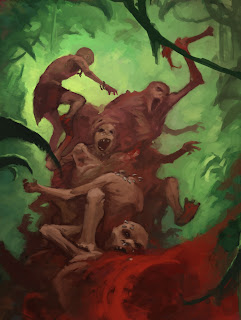
This tower of body parts reeks of death, the stench filling the jungle. A massive stack of arms, legs, torsos, and dangling viscera looms above. Embedded within this tower of flesh, at least three stacked heads rotate wetly in place, eye different foes, gnash pointed teeth or shout battle cries. The totem warrior waves its amalgam of stitched arms, slamming opponents and bathing them in gore.

FAH-JEE TOTEM WARRIOR CR 9
XP 6,400
NE Large undead
Init -1; Senses darkvision 60 ft.; Perception +20
DEFENSE
AC 16, touch 8, flat-footed 16 (-1 Dex, +8 natural, -1 size)
hp 110 (13d8+52)
Fort +8, Ref +3, Will +9
DR 10/good; Immune undead traits; SR 20
OFFENSE
Speed 20 ft.
Melee 4 slams +13 (1d8+5 plus grab)
Ranged fling +7 (1d6+5 plus disease)
Space 10 ft.; Reach 10 ft.
Special Attacks bathed in blood, disease, fling
STATISTICS
Str 20, Dex 9, Con —, Int 2, Wis 13, Cha 18
Base Atk +9; CMB +15; CMD 24
Feats Alertness, Blind-Fight, Improved Bull Rush, Improved Overrun, Point–Blank Shot, Power Attack, Precise Shot
Skills Intimidate +8, Perception +20
ECOLOGY
Environment jungle
Organization solitary
Treasure none
SPECIAL ABILITIES
Bathed in Blood (Ex) A regularly fed fah-jee totem warrior stores blood and other mortal juices within its massive body. Every 1d4 rounds, as a standard action a fah-jee totem warrior can erupt in a fountain of blood, bathing all creatures within 15 feet in slippery red ichor. Any creatures in this area must succeed on a DC 17 Reflex save or fall prone. This spray of gore remains slick afterwards, requiring affected creatures to make a DC 15 Acrobatics check every round to move normally within the area. Affected creatures can spend a full-round action to clean themselves off, drawing an attack of opportunity but permitting them to move normally within the area thereafter. Fah-jee totem warriors are unaffected by their own ability, but other fah-jee remain vulnerable to the slick, gruesome mess. The save DC is Dexterity–based
Disease (Ex) Fah-jee rot: Fling—injury; save Fort DC 20; onset 1d2 days; frequency 1/day; effect 1d6 Con and 1d6 Cha damage; cure 4 consecutive saves. The save DC is Charisma-based.
Fling (Ex) A fah-jee totem warrior can rend rotten parts from its body – wriggling arms, kicking legs, mummified heads, and other viscera – and throw them at its enemies as weapons. As a full-round action, a fah-jee totem warrior can make three ranged touch attacks at a range of 90 feet with no range increment. Each attack deals 1d6+5 points of damage and the creature struck risks contracting fah-jee rot.

Notes: This horrid creation serves as both a revered member of the fah-jee tribe and its best protection. Fah-jee totem warriors are only found at the center of a fah-jee tribe’s village. Composed of dozens, sometimes hundreds, of different body parts, fah-jee totem warriors represent the pinnacle of tribe’s passage into the unity of undeath. Fah-jee totem warriors reek of slaughter and rot. Their scent blows through the trees near fah-jee villages, warning living creatures away lest they end up in a fah-jee cookpot.

Tactics: Slow to move, fah-jee totem warriors usually let their enemies come to them. They rely on their many slam attacks to bludgeon and grapple foes and enjoy ripping enemies apart if possible. Against clever foes who keep their distance, fah-jee totem warriors tear their own limbs and non-functional heads from their towering body and pelt invaders. Fah-jee totem warriors display a basic animal intelligence. They follow the orders of their fah-jee hunas with unswerving dedication, though the hunas must be extremely clear in its commands.

Leaking gore and glaring down on all who surround them, fah-jee totem warriors are twice as easy to detect by scent as a standard fah-jee. Fah-jee totem warriors stand 12 feet tall and weigh upwards of 1,500 pounds.

Fah-jee Variants
Fah-jee possess an impressive understanding of their undead bodies and frequently perform modification rituals to enhance their dead flesh with parts from non-human creatures. Apply the following two variants to ordinary fah-jee and fah-jee hunas only, as the fah-jee totem warrior is itself a modification.

Aquatic Fah-jee Flippers from a sea turtle or the sweeping fins of a shark replace arms or legs in this mash-up of humanoid body parts and chunks of whichever creatures swim near fah-jee infested islands. To make an aquatic fah-jee, give the creature a swim speed of 40 ft. The fah-jee gains the aquatic subtype. This modification does not increase the base creature’s CR.

Brachiating Fah-jee Using the long arms of monkeys and apes, fah-jee hunas modify some members of their tribes to better hunt the jungle canopy. To make a brachiating fah-jee, give the creature a climb speed equal to its current land speed. If ape arms are used, increase the damage for the creature’s slam attack to 1d4. This modification does not increase the base creature’s CR.

In addition to these two common modifications, GMs may create more aggressive modifications by using the giant simple template or the advanced simple template. This method works best for a quick variant, but fah-jee typically advance by taking class levels, with warrior NPC levels the most common. Fah-jee hunas never allow fah-jee tribesmen to pursue spellcasting classes, and fah-jee tribesmen who do follow that path face death, their bodies torn apart and embedded in totem warriors or other abominations.

Fire As She Bears


Design your own ships from the hull out and fight Age of Sail combats like you've never fought before!

Hoist the staysails, catch the weather gauge, you have the helm sir! All cannon, the enemy is in sight. FIRE AS SHE BEARS!

Building on the winning entries of a contest to create new rules, authors Lou Agresta and John Ling, with contributions from James MacKenzie, wrote a book to empower players and GMs to fight cinematic “Master and Commander” style ship battles in Pathfinder or Swords & Wizardry that stay true to the spirit of history and Age of Sail realities.

This complete 50+ page subsystem of ship-to-ship combat, includes over 35 new magic items for characters and ships, new feats, new uses for familiar skills, new weapons and equipment, new spells, and best of all? Roll up and equip an Age of Sail warship just like you’d design a new character – in as little as 30 minutes.

Isn't it time every player at the table had a hand, every round, in sinking the enemy ship?

Question and Answer

Backer Spence asks: I have seen a large number of settings that purport to be nautical and involve ships of sail. And yet not a single one did. They mostly had fantastical or to be more precise nonsensical ship rules and really idiotic ship plans. Nothing crushes the suspension of belief like non-existent ship rules. So the question is this. Have you picked an era to base your ships on and has anyone read an actual book covering ships design of that period? 

Lou Agresta answers: I did choose a time period on which to model the ship rules. Late 16th through the Napoleonic, recognizing that many late 16th century ships still hung around into the early Napoleonic era depending on your geographic arena. In addition to liberal use of wikipedia, I relied on O'Brien's Aubrey/Maturin novels (themselves historically well researched) and Little's The Sea Rover's Practice (1630-1730). For my own part I minored (oh so long ago) in military history with a particular focus on naval history. I used the historical HMS Surprise (originally French) of 1796 as my loose cap on naval advances and technology. 

While its possible to design a gonzo, magically tricked out ship of the line with the Fire As She Bears rules, there core focus is to bring battles on a ship like the HMS Surprise to life in a fantasy setting. I tried to keep the historical constraints in play that make naval combat challenging and fun -- and hold the unique flavor of Age of Sail battles. However please be advised the rules are not an attempt at historical simulation. Rather I used historical reality as a guide to verisimilitude and to "keeping it in line". Where my heart really called out for rules that echoed historical naval development and tactics of the period, I created advanced rules. For example, there is an advanced rule for introducing "getting the weather gauge" to naval combats. We simplify wind effects to "for and against" but I couldn't resist an advanced rule that covers points of sail, so that we can pull in the gamut of beam reach, close-hauled, etc. and have it impact the engagement, if that's your bent. I finally had cave and abandon advanced rules for rigging and sail plans, I regret to say. The complexity drifted over the "game" line into simulation. Instead I've contented myself with allowing the creation of a number of rigging locations limited by the number of hull locations, so that masts and sail configurations inherently match historical realities (within a reasonable degree). 

I may write a supplement after we're funded of more advanced rules for those of us who really dig this end of things. The primary design goal, however, was to make sure that in every single round of naval combat, every player at the table has something fun and meaningful to do. To solve that problem I allow the players to take on ship roles (captain, mate, gunner), allow them to lead crew, and give them the ability to solve ship problems or improve performance. On a player's turn they can do the things they normally do (cast a spell, etc.) plus do the things that their role on the ship lets them do: improve the accuracy of the port broadside, lead the marines to repel boarders, shift the ship to steal the wind from the enemy sails, take a team below to plug leaks, etc. 

Finally, crew are a resource. The more of your crew that get shot up, blown up, eaten, knocked into the ocean the harder it gets to fight the ship and the more the PCs have to step up their game and become ship's heroes. Loose too many crew and you can't fight your ship. Ultimately, the rules aim for slightly cinematic Master and Commander style battles of the sort that appear in O'Brien's novels. They allow for fantasy elements, firmly stay a game and not a simulation, but are constructed on and constrained by historical reality. I hate exploding cannon balls, for example. Most of all I wanted true Age of Sail flavor.

Saturday, January 19, 2013

2nd Bonus Goal Reached!

We will now publish the player's guide as a hardcover book. All the pledges that include the book (as well as the pledges that have added the book as an add on) will now receive a hardcover instead of a softcover. 

Keep spreading the word so we can reach the next goal! Thank you!

At $85,000 we will publish the Heart of the Razor as a hardcover book.

You can add on a print version of Heart of the Razor for $40 to any pledge. You can add on a PDF only to any pledge for $20. Note: All Frog God Games print products come with a PDF.
Join us Sunday 1/20/13 at 6pm PST for an interview by Chronicles Pathfinder Podcast with Lou Agresta, Nick Logue, and Greg Vaughan live on Google+ Hangout. 

These unedited, talk-show style shows will feature industry & listener guest appearances, gaming news and current events. Add Mike Azzolino to your Google+ friends to join the hangout.

Friday, January 18, 2013

Funded and 1st Bonus Goal Reached

We hit our bonus goal so we will publish the Heart of the Razor (4 new adventures by Richard Pett, Owwen KC Stephens, Gary McBride, and Tom Knauss). The PDF of these adventures will be added to all the pledge levels at or above $150 and softcover print books will be added to all the pledge levels at or above $250.

All pledges may add on the Heart of the Razor Print Book w/ PDF for an additional $40 or the PDF only for an additional $20. You can specify on the survey what any additional funds to your pledge are for.

New Bonus Goals

At $82,500 we will publish the player's guide as a hardcover book.

At $85,000 we will publish the Heart of the Razor as a hardcover book.

At $87,500 we will print and publish Fire As She Bears. Roughly 48-60 full color page softcover book, this complete subsystem of ship-to-ship combat can be added to any pledge for an additional $15. 

At $90,000 we will create the D20Pro maps and the Hero Lab data files for Razor Coast. More to come on this goal.

Thank you again to our backers!

From the Words of Lou

We funded -- and made the first stretch goal the same day! I'm overjoyed. The 4 adventures in Heart of the Razor are top notch by great writers. Tons of fun, ahead.

In celebration I want to share one of my favorite opening moments in Razor Coast. It includes one of my favorite lines. Not entirely sure why it's my favorite, actually. There are scenes with more subtle awe. Razor Coast contains more striking, more startling, and more bloody scenes for sure. There are more tender moments, more heroic choices, more ass kickin' moments for sure. But something about this one, one the docs, just _brings_ me there. Cynthia Sheppard illustrated it, which always is a plus in my book, and I think -- in this book.

In general, Razor Coast read aloud text remains short and concise. This is one of Nick's longer read alouds. Here's the scene:

Anglers by trade since their long-spent youth, now worn by the waves, a gaggle of grizzled men sit hunkered down on the docks by the gangplank of an old barnacle-crusted fishing sloop. A dozen old men, sprinkled with a few younger fisher folk, huddle around a man of forty or so winters. His eyes quaver and his lips tremble as he launches into his tale:

"We's a ways out. Making hard time. The wind was ‘gainst us, and we’d just passed Beacon Island by the settlin’ in o’ dusk. That’s when the sloop gave a mighty lurch. We hit something, so the captain thought at first, but no… it felt like somethin’, well, like somethin’ hit us! Then the sloop rocked again and the cap’n feared we’d run upon the shoals, but before he could snap an order somethin’ slammed our port side hard. The captain lost his footin’ and tumbled into the deep. Never came out. That’s when I saw it, I did. Blacker than the darkness, blacker than the night’s water around us…”

“Ain’t no such thing…as a black shark,” a young man on the edge of the crowd snaps.

“Night black it were! These eyes been at crow’s nest for thirty years!” The older man snarls in retort.

“Thirty years ago t’were sharp is sure, but not so now you old sea dog. Sun on the water burned out your eyes years ago.” A few laughs answer this retort, but no real mirth flows from them.

“Batten yer hatch. What’s a guppy like yerself know from sharks? It were blacker than the heart of midnight.”

“There be no such thing!” insists the youngster.

A voice, like a knife across stone, cuts the air: “There be a black shark.”

The crowd parts to reveal an ancient man of the sea. His leathery skin stretched over his bones, he raises his right arm to silence the boy’s reply. The arm ends in a cold black iron hook. The old man’s one good hand clutches a wooden crutch, supporting his wracked frame. His leather breeches are cut off at the knees and two gnarled wooden pegs, chipped and scratched from wear, extend from the stumps of what remains of his legs. “There be a black shark.” His voice rasps once more.

A thick silence settles over the crowd then; no one wants to debate the shark’s existence any more. One of the younger fishermen even hazards a glance off the pier as if he expects a dark fin to crest the waves at any moment. With muttered excuses and leave-takings the crowd of fishermen breaks up, leaving the old man alone on the pier, his back to the dock, staring across the roiling sea.

* * *

So say it with me, folks. "There be a black shark!"

Razor Coast has funded!

We are excited to announce that Razor Coast has funded. THANK YOU! We are working toward the Bonus Goals now. Check it out at: http://www.kickstarter.com/projects/froggodgames/razor-coast

Also you can listen to Lou's detailed description of Razor Coast here:
http://www.conmenpodcast.com/2928/episodes/episode-17-razor-coast/
By: Con-Men Podcast
Description: Razor Coast is the long anticipated Caribe-Polynesian flavored, Age of Sail swashbuckling RPG campaign envisioned and designed by Nicolas Logue. It is applauded for its ambitious and original design, its epic flavor and its lurid, full-color art – including a cover by the award winning Wayne Reynolds. Logue tapped a team of veteran designers to help develop and write Razor Coast, including Lou Agresta, Adam Daigle, Tim Hitchcock, and John Ling. On this episode, I speak with Lou Agresta, a talented game designer and master ConMan. Check back next week for the second half of this interview where I continue my talk with Lou about the Iron GM competition.

Tuesday, January 15, 2013

Frog God Games will be at Gen Con 2013


Frog God Games will have a booth at Gen Con this year!! 

Bill Webb will be running NEW Swords & Wizardry Events. Skeeter Green will be running the NEW Rappan Athuk levels as Pathfinder Events. Blonde Frog and Jen Frog will be manning the booth. We have a yet another big release this year. So stay tuned for that.

WHAT IS GEN CON?
Gen Con is a consumer and trade experience dedicated to gaming culture and community.

Celebrating its 45th year in 2012, Gen Con "The Best Four Days in Gaming!" has become the largest annual consumer fantasy, electronic, sci-fi and adventure game convention in North America. Each year gaming enthusiasts converge to share their enthusiasm for all things gaming; whether its tournaments, celebrity appearances, exhibit hall booths, electronic games, workshops, seminars, anime, art shows, auctions or countless other activities.

With an avid following of more than 120,000 consumer and professional attendees, Gen Con is THE destination for everyone from serious fans, to those simply interested in casual gaming. Many people ask "Gaming? What kind of Gaming?" Gen Con appeals to all hobby gaming enthusiasts, essentially all gaming except sports and gambling.

Game manufacturers and publishers consistently utilize Gen Con as the place to launch new games and new products, show off the latest and greatest game expansions and features, and host incredible tournaments. From world championships awarding thousands of dollars to non-professional games created by passionate enthusiasts, playing games is what it's all about.

WHERE IS IT HELD?
Gen Con takes place each August at the Indiana Convention Center in Indianapolis, Indiana. Gen Con Indy is non-stop, around-the-clock gaming including role-playing games (RPG's), trading card games (TCG's), video and computer games, miniatures, board games and more. Over 11,400 scheduled, ticketed events and hundreds of exhibitors make Gen Con the can't miss event on every gamer's calendar.

WHAT KIND OF GAMING EVENTS HAPPEN AT GEN CON?
Gen Con is the quintessential "meeting ground" and "battleground" for all types of gaming for all ages. Attendees come to participate in RPGs, TCGs, card games, board games, family games, live-action role-playing games (LARPs), miniatures, video and computer games, and more.

WHAT OTHER EVENTS ARE AVAILABLE AT GEN CON?
The four days are full of plenty of hobby-related events as well, such as:
The Family Fun Pavilion, an E-Game Arena, a Costume Contest, life-size 10,000 sq. ft. True Dungeon, gaming auction, the largest sci-fi and fantasy art show in the country, over 300 exhibitor booths, Authors Avenue, anime, seminars, panels and workshops, Training Grounds (area dedicated for children), film festivals and more.

THE VISIONARY BEHIND GEN CON
Peter Adkison, founder and former CEO of Wizards of the Coast, is the owner of Gen Con, LLC. Peter purchased Gen Con from Wizards of the Coast in 2002.

LOCATION
While the annual event takes place each summer in Indianapolis, Gen Con's corporate office is headquartered in Seattle, Washington.

BRIEF HISTORY
Gen Con is a name that has been with the gaming world for more than 45 years. It began as a meeting between friends to play games in Lake Geneva, Wisconsion- thus the name Gen (Geneva) Con (Convention). Today that name lives on in the gaming industry as the place to go to experience The Best Four Days in Gaming! Currently Gen Con has licensed events in Europe (France and the UK) and Australia.

TO ATTEND
Gen Con Indy will be open to the public Thursday, August 15-18, 2013.
The exhibit hall will be open each day with limited hours, however gaming takes place at the convention center and at surrounding hotels 24 hours a day during the 4-day event. The convention will take place at the Indiana Convention Center.


Badge Pre-Registration opens:  January 27th at Noon (Eastern)

Event Registration opens:  May 19th at Noon (Eastern) 


Monday, January 14, 2013

Razor Caost Sneak Peek #7


Lou Agresta shares "He owns a fishing supply store. Really. Just a fishing supply store. Honest, cross my heart. Introducing (for some, reintroducing) One of my favorite off-beat dramatis personae, Old Fish. Here's an old man who can teach you a thing or two."

Here from across the ocean. Where specifically? Oh here and there? He just thought he'd travel a bit in his retirement, finally doing as an old man what he'd always hoped to do as a young one. On the wall? Oh nothing. Just some old junk weapons the sewer pirates dig up every now and then. So fish. Fishing gear. A crossbow or two. The needles? Nothing. Just for nets. Oh. I sell maps too. Maps of the area. Got a treasure map to Garr Bloodbane's Gold around here. 100% authentic. Guaranteed. Now what'd you say I can get you? And here, while you're thinking, take a look at this map.


Frank Mentzer Interview

Interview from Kobold Courier  

Frank Mentzer is one of the first generation of D&D designers, and his work is well-known to the old guard AD&D players and OSR types. We caught up with him to ask these questions three.

Mr. Mentzer, you have written some classic adventures for D&D. What makes an adventure stand the test of time? What makes it connect with players?

There are too many successful types to shove them all into one narrow answer. Some seminal adventures are the beginnings of entire campaigns (B1, B2, and G1 are often cited). Some have awesome moments, visuals, or bad guys. Almost all the best and most memorable contain some version of The Big Finale: the whole story leads to one pivotal moment, one or more characters die heroically, but the survivors pull off a victory 'against all odds', get the treasure, and retrieve their fallen. That can apply to a lot of good adventures, and certainly not just those by TSR.


Pirates are fairly popular, and shark gods are cool. What else makes the Razor Coast worth a gamer's hard-earned cash?

It has built-in variety unified by a popular topic. Historically, seafarers have come in lots of flavors, and the 'independent adventurer' equates reasonably well to 'pirate'... while omitting the historical realities (they were poor, often a slave or prisoner, and life was cheap and short). So that part is a no-brainer.
   The coolest element is Frog God's (admittedly recent) record. Look at everything produced in the last few years, and this relatively new company keeps creating stand-out stuff... Rappan Athuk, Slumbering Tsar, the Tome of Horrors ultimate monster-book, and even the 'retroclone' Swords & Wizardry rule set. The customer can count on the quality of writing and art. 
  
Do you think adventures and campaigns are more about the designer's vision, the GM's session plans, or the player choices? Who really makes or breaks a great game?

A healthy gaming group decides what it wants as a whole. The players and Game Master synergize; neither dictates the terms. N00bs should start with the Rules As Written (RAW) and try published modules to see how the pros do it -- those who have been doing this for up to 40 years. But the beauty of roleplaying as social entertainment is customization, and with just a bit of experience, the entire gaming group can decide what parts they like and what they don't... individual rules, styles of play, and more.

   The designer's (or GM's) vision is a starting point, but is best customized for the players' tastes. A 'great game' is entirely subjective. One group may prefer hackenslash dungeon crawls, a totally escapist (and arguably juvenile) respite from realworld cares. Another may prefer negotiations, roleplaying in depth, and other more sophisticated methods -- perhaps as an elevation from realworld boredom containing none of that. 

   The answer for all is obviously a setting that's self-consistent and acceptably exciting, but with plenty of opportunities to cook it the way you want. The old saying about 'too many cooks' is inverted here; when it comes to ideas, the more the better. Razor Coast is a good soup-stock with several servings as-is; from there, it'll be easy to 'season to taste' and keep dishing it out when the given adventures are done.

Thank you, Mr. Mentzer, and we look forward to seeing what you do with Razor Coast!

Related posts

Related Posts Plugin for WordPress, Blogger...